Most content teams share the same Monday morning ritual. They sit down, stare at a blank screen, and try to conjure something brilliant out of thin air. Then they do it again Tuesday. And Wednesday. By Friday they are running on fumes and reposting a quote graphic nobody is sure is even on brand.
Here is the good news: you do not need more ideas. You need to squeeze more out of the ones you already have.
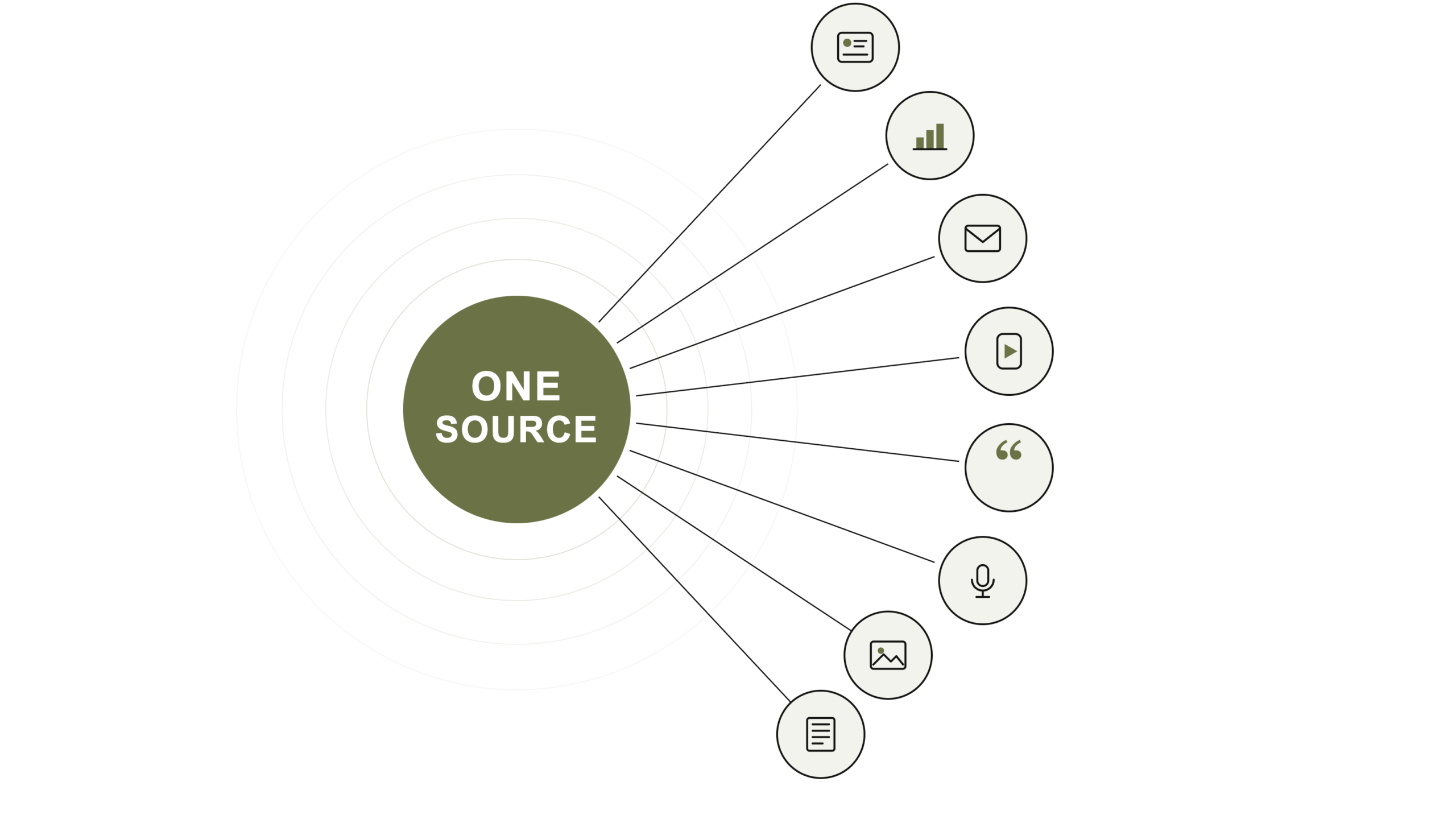
We call it the One-Source Content Engine, and it has quietly become the backbone of how we operate. The premise is simple. You start with one solid piece of source material, a feature article, a customer interview, a webinar recording, whatever you have, and you treat it as a quarry rather than a finished product. One good source can fuel a week of content across every platform you care about.
Start with the anchor. Write the long piece first, the one that says something worth saying. This is your source of truth, the place every other asset traces back to. Get it right and everything downstream inherits its quality.
Then start mining. That single article becomes a LinkedIn post built around its sharpest insight. The most surprising stat becomes a graphic. A strong paragraph becomes the body of a newsletter. The argument becomes a ninety-second vertical video where you say it to camera. A behind-the-scenes note becomes a story. Suddenly one source has become eight pieces of content, and not a single one started from a blank page.
The trick that makes this work is sequencing, not volume. Each piece points back toward the anchor, so your week of content is not eight random shots in the dark. It is eight angles on one idea, which is exactly how audiences come to actually remember what you stand for. Repetition is not a bug here. It is the entire point. People need to hear something several times before it sticks, and the Engine lets you repeat yourself without ever sounding like you are repeating yourself.
This is also where AI earns its keep. Once you have the anchor written, the right tools can draft the social variations, reformat the newsletter, and pull the pull-quotes in minutes, leaving your team to do the part that actually requires a human: deciding what is good and what is not. The machine handles the reformatting. You handle the judgment.
The businesses that win at content are rarely the ones publishing the most. They are the ones with a system. While everyone else is inventing from scratch every single day, you are working from a single source and letting the workflow do the heavy lifting.
One source. A full week of content. No blank pages. That is the whole game, and it is a lot more repeatable than waiting around for inspiration to show up on schedule.